Will agentic commerce push more merchants into marketplaces?
Will agentic commerce push more merchants into marketplaces?
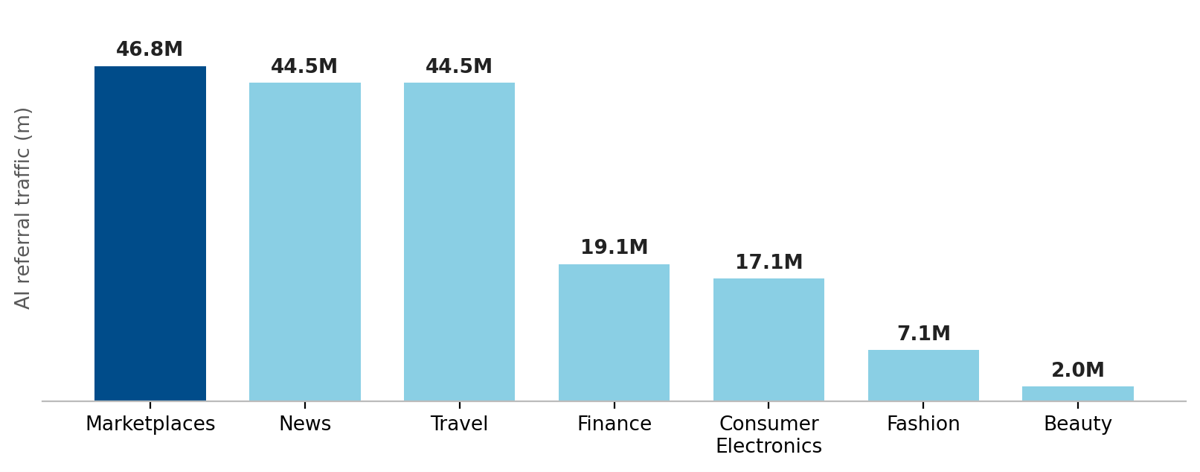
Agentic commerce has cleared its first hurdle, that of consumer demand. ChatGPT handles an estimated 50m shopping queries a day1, and AI-referred traffic to US retail sites rose by nearly 400% in the first quarter of 20262. The unresolved question is where that demand settles once a purchase is made. The early evidence points to the scaled, branded marketplace. According to Similarweb, marketplaces already receive more AI-referred traffic than any other retail category, some 47m visits in the year to May 2026, and continue to grow faster than their scale would predict3. The mechanism is a mutually reinforcing relationship between consumer preference and LLM recommendation, and its logic points towards a concentration of agent-led commerce on large platforms, with material consequences for merchants and their payment suppliers.
The pattern in AI referral traffic
Revealed consumer preference is a much more reliable guide to market development than stated intent, and the traffic data for agentic commerce is gradually building a picture of how consumers actually use agentic commerce rather than just speculation. Similarweb’s recent analysis ranks marketplaces first among retail categories for AI-referred visits, ahead of news, travel and finance (Figure 1). Two features are notable. The category commands the largest absolute volume of click-through traffic, and it continues to expand at more than 230% a year despite that already substantial base3. The explanation lies in how large language models (LLMs) assemble their recommended shortlists. Faced with an open-ended shopping request, a model favours platforms with broad catalogues, well-structured product data and extensive reviews. Large marketplaces can provide these in abundance by providing a single source that can satisfy the widest range of queries with the strongest supporting evidence.
Figure 1: AI referral traffic by category, worldwide, June 2025 to May 2026
Source: Similarweb, Gen AI Landscape: The Evolution of AI Search, July 2026; PSE analysis.
Testing the democratisation thesis
A contrary hypothesis has been influential. Shopify’s president, Harley Finkelstein, has characterised agentic commerce as ‘fundamentally merit-based’4, arguing that it would widen discovery to the long tail of smaller merchants rather than reinforce the incumbents that dominate conventional search. The demand is not in doubt: Shopify reports that AI-referred traffic to its stores has risen roughly eightfold in a year5. The distribution of that demand, however, is less even than the thesis implies. Marketplaces, not independent sellers, are absorbing the largest share of AI referrals, and the agentic platforms attempting broad merchant onboarding have found it difficult. OpenAI has scaled back open instant checkout in favour of a smaller set of curated partners, citing the complexity of onboarding and verifying merchants at scale6.
The emerging structure is therefore symbiotic. Marketplaces supply a large, trusted brand within which a long tail of smaller sellers operate. The individual merchant still reaches the agent-guided shopper, but within a brand and trust environment the consumer and the model already recognise. This arrangement addresses the consumer trust problem that the open web does not, since the platform has verified the seller before the listing appears, and it retains the operational layer, fulfilment, dispute resolution and logistics, that an agent appear unwilling to take responsibility for. The long tail is not excluded so much as commercially enabled by marketplaces.
A self-reinforcing loop
Beneath the traffic figures lies another dynamic that has received relatively little analysis. Consumer preference and algorithmic recommendation reinforce one another. Consumers already trust marketplaces in a traditional eCommerce use case and select them when an agent presents the option. Learning models, optimised on the recommendations consumers select, are more likely to surface marketplaces more frequently, reinforcing the habit and shaping the next recommendation. Over successive interactions the marketplace becomes both the more probable choice for the shopper and the more probable output of the model.
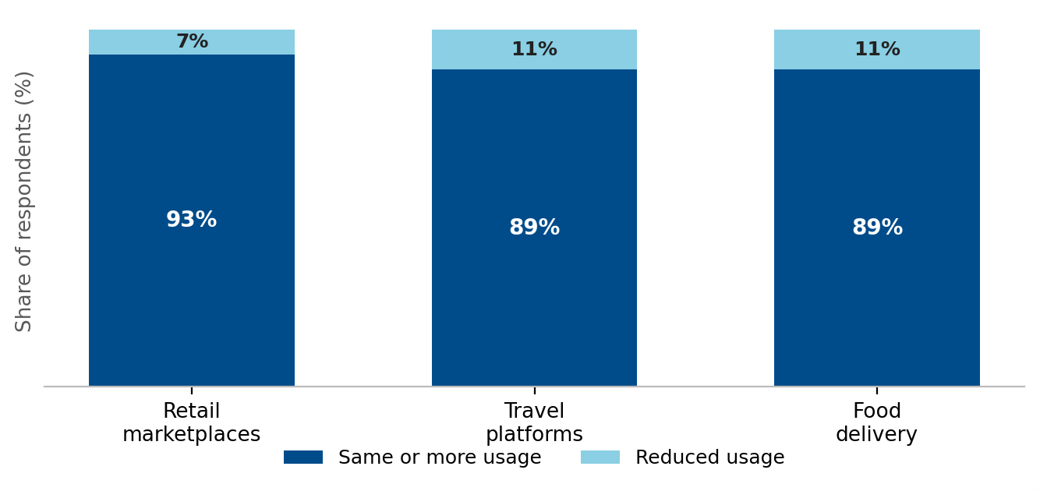
PSE’s recent international survey of agentic shoppers indicates that these outcomes are already in consumers’ minds. Consumers tell us they are looking for an independent (i.e. non-seller embedded) agent to compile the shortlist, followed by the reassurance of a familiar brand and visible reviews, a combination that large LLM brands and marketplaces are well placed to provide. PSE’s research showed that 74% of agentic shoppers in the US and Europe favour an independent assistant capable of comparing across sellers, against 10% who prefer one embedded within a single seller. Brand recognition is also important to 89% of respondents, and customer reviews to 93% when deciding which recommendation to pick from an agent’s shortlist. Most significantly, 93% expect to use retail marketplaces as much as or more than before as the adoption of agentic commerce grows (Figure 2)7.
Figure 2: Expected use of marketplaces as AI adoption grows (% of consumers)
Source: PSE Agentic Shopping Survey, March 2026 (n=4,250).
Why marketplaces hold the advantage
Consumer preference is only part of the explanation. The economics facing the agent point in the same direction, for three reasons. The first is remuneration. Most large marketplaces operate established affiliate and commission schemes, providing a ready mechanism to reward an agent for delivering a customer. As agents assume the role once played by referral sites and publishers, the marketplace platforms with mature payout infrastructure are the simplest to monetise. The second is conversion. Marketplaces have invested heavily in low-friction checkout, so an agent compensated on completed sales rather than referrals has reason to direct shoppers where a purchase is most likely to conclude, which compounds the commercial pull towards the platform. The third is payment. Agentic commerce already leans heavily on credentials held on file. The dominant standard, Google’s Universal Commerce Protocol (UCP), only transacts against tokenised credentials held on file rather than card details entered by hand, and marketplaces already hold card credentials for hundreds of millions of shoppers8.
The advantage is not only the agent’s. Agentic commerce is still nascent: technical standards are still emerging, liability and commercial terms are unresolved, and fraud is migrating to the channel. Absorbing that uncertainty requires capital, specialist staff and an appetite for risk. Large marketplaces can invest through the ambiguity, adopt and switch between emerging protocols, and operate the fraud and dispute controls the channel demands. For most mid-sized and smaller merchants, the same burden is disproportionate to their means and their tolerance for risk, a further reason to participate through a platform rather than to carry the complexity alone.
An acceleration, not a departure
The movement towards marketplaces predates agentic commerce, and there is a long list of large retailers that have already built or joined them. Kingfisher opened a third-party marketplace at B&Q in 2022, and such sales now represent around 40% of B&Q’s online revenues9. Tesco launched Tesco Marketplace in June 2024 and listed more than 300,000 third-party lines within eight months10. Target has told investors it intends to expand its invitation-only Target Plus marketplace from more than $1bn to more than $5bn in gross merchandise value within five years11. In each case a trusted retail brand hosts a long tail of smaller sellers, the configuration the referral data now rewards.
Implications for merchants and acquirers
The likely consequence is that agentic commerce accelerates this migration, and that the reinforcing loop strengthens rather than dilutes the move towards marketplaces. The effect will likely divide according to the scale and strength of a merchant’s brand. Larger, well-known retailers may choose to become marketplaces in their own right, hosting third-party sellers beneath their own name, as Kingfisher, Tesco and Target have done. For smaller merchants the choice is more likely to be additive: most will want to retain a direct presence while also selling through one or more established banners, drawing on the reputation of the host and a position within the recommendation loop. This is the next stage of a long-standing movement of smaller firms into marketplace distribution rather than a break from it.
Direct commerce will not disappear. Merchants with strong brands, machine-readable reviews and genuine loyalty can still secure the agent’s shortlist independently, and Salesforce reports that retailers operating their own shopping agents have grown sales roughly 60% faster than those without12. For the broad middle of the market, however, and particularly in impersonation-prone categories such as fashion and footwear where consumers and their agents may have concerns about seller trust, a marketplace presence may become a competitive requirement.
For acquirers, the shift accelerates a migration of volume that is already underway by moving spend onto a smaller number of large platforms. Meanwhile the direct-merchant portfolio shrinks and may be exposed to elevated fraud risk as fraudsters exploit the weakest validation layer. Acquirers with strong exposure to the marketplace segment are well placed, while the rest of the market faces yet another reason to move into the platform economy.
Sources
1 OpenAI Economic Research with David Deming, early 2026.
2 Adobe Analytics, via Digital Commerce 360, 2026.
3 Similarweb, Gen AI Landscape: The Evolution of AI Search, July 2026; PSE analysis.
4 Harley Finkelstein, Shopify Q1 2026 earnings call, via Retail Brew, January 2026.
5 Shopify Q1 2026 earnings call.
6 CNBC, March 2026.
7 PSE Agentic Shopping Survey, March 2026 (n=4,250).
8 Google, Universal Commerce Protocol, announced January 2026.
9 Kingfisher plc and Mirakl, 2022 to 2026.
10 Grocery Gazette, January 2025.
11 Target investor guidance, via Digital Commerce 360, March 2025.
12 Salesforce Agentforce Commerce, July 2026.
13 PSE estimate, 2026.